Book Appointment
Chat with usA tax receipt from 1663 records Ajmo Barbero selling a grey serge to the Duke of Savoy. That scrap of paper makes this the oldest continuously family-owned wool mill in the world with a documented start date — and the thirteenth generation is still running it.
In short: Vitale Barberis Canonico is an Italian wool mill in the Biella valley, documented from 1663 and owned by the same family for thirteen generations. It is fully vertically integrated — combing, spinning, dyeing, weaving and finishing all happen in Piedmont — producing around nine million metres a year. ŠAKAL holds its bunch books at our Jalan Besar atelier in Singapore and cuts them bespoke.
FIRST DOCUMENTED SALE
GENERATIONS, ONE FAMILY
METRES A YEAR
WEEKS, BESPOKE
The founding date is not a marketing claim but a document. A quinternetto delle taglie — a tax record — from 1663 notes Ajmo Barbero selling a saia grisa, a grey serge, to the Duke of Savoy. The family was almost certainly weaving before that; 1663 is simply the earliest year they can prove.
The business mechanised in the mid-1800s under Giuseppe Barberis Canonico, took delivery of its first mechanical frames in 1868, and consolidated everything at Pratrivero, where a full-cycle factory followed electrification in 1910. The name Vitale Barberis Canonico was formally established as a trading name in 1936.
It is one of very few genuinely vertically integrated worsted mills left. Wool is bought at source in Australia; combing, blending, spinning, dyeing, weaving and finishing all happen in the Biella valley. Around nine million metres a year, roughly 80% of it exported. Biella’s naturally soft water is the reason the district became a finishing centre in the first place.
The family has never sold. Thirteen generations on, three cousins — Alessandro, Francesco and Lucia, grandchildren of the Vitale in the name — run it. In 2013 the house joined Les Hénokiens, the association of businesses owned by the same family for more than two hundred years.
Every house has a temperament. This is what to expect from this one, and why we reach for it.
The single most useful thing about VBC to a working tailor. A cloth cut today behaves exactly like the same cloth cut three years ago, because one company controls every stage.
Perennial is a Super 110s at 260 grams and the house calls it the suit fabric for work. That is an honest description — it is the least fashionable and most useful cloth we hold.
From Super 110s workhorses to Greenhills at Super 180s, plus mohair, linen, flannel, cashmere and the Solaro. Very broad, very even in quality.
A range built on South American wool from Argentina and Uruguay, including the Montecarlo jacketing at 280 grams — a good summer jacket cloth for this climate.
Biella’s soft water gives the final wash that takes coarseness out and brings lustre up. VBC treats its wastewater through natural ponds and reports using about half the water of a typical mill.
Undyed natural fibres, recycled wool blends and cloths dyed with natural pigments. A serious sustainability range rather than a token one.
Cloth only tells you so much. This is what it looks like once it has been drafted, cut and finished on ŠAKAL.
Short answer: there is no single price, because Vitale Barberis Canonico is a range rather than a product. A standard worsted and a rare-fibre cloth come from the same house and cost very different amounts. We quote once you have chosen the cloth and the garment — with the figure attached to every option in front of you, before anything is cut.
A classic worsted and a pure cashmere sit at opposite ends of the same merchant’s range. The book you choose moves the cloth cost more than anything else.
Superfine merino, cashmere, silk and mohair blends cost more per metre than a standard worsted, because the fibre itself is scarcer.
A two-piece suit takes roughly 3.2 to 3.5 metres of 150cm cloth. A three-piece, a larger frame, or a pattern that must be matched across seams all take more.
A suit, a jacket, trousers, or a full three-piece are different quantities of cloth and different amounts of work on the bench.
Full canvas, half canvas, lined or half-lined, hand-finished details — these are decisions about the garment rather than the cloth, and they move the figure too.
We price after you have chosen, not before. At the consultation we put options across the range in front of you with the figure attached to each, so nothing is a surprise.
Held in Singapore, not ordered in blind. Turn the pages, handle the cloth, see it in daylight next to the alternatives — then decide.


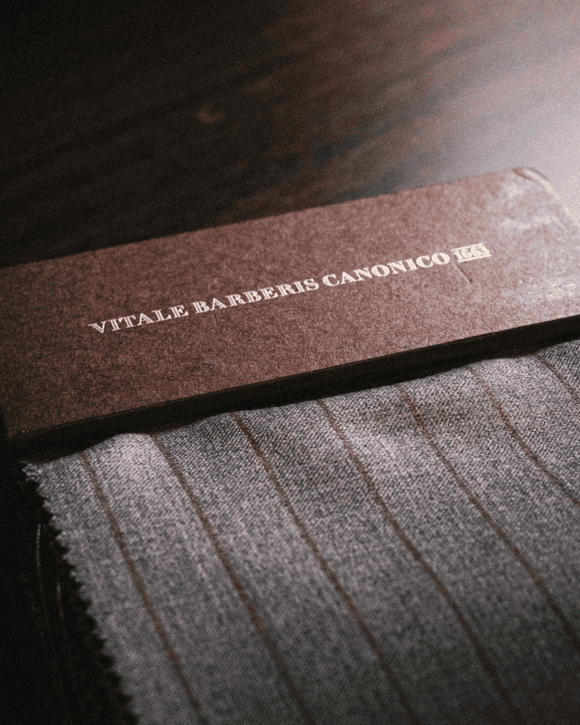
Yes. ŠAKAL holds VBC bunch books at our atelier at 157A Jalan Besar, Singapore, including Perennial and Revenge, which are among the cloths we cut most often. The books are in the shop rather than ordered in on request, so you can handle the cloth in daylight before committing.
Vitale Barberis Canonico is an Italian wool mill in the Biella valley of Piedmont, documented from 1663 and owned by the same family for thirteen generations. It is fully vertically integrated — combing, spinning, dyeing, weaving and finishing all happen in Biella — and produces around nine million metres a year, roughly 80% of it exported. It has been a member of Les Hénokiens, the association of bicentenary family businesses, since 2013.
The date rests on a surviving tax document — a quinternetto delle taglie — recording Ajmo Barbero selling a saia grisa, a grey serge, to the Duke of Savoy in 1663. It is a receipt rather than a company charter, and the family was very likely weaving before that; 1663 is simply the earliest year they can evidence. That makes VBC the oldest continuously family-owned wool mill in the world with a documented start date.
It means one company controls every stage. VBC buys wool at source in Australia, then combs, blends, spins, dyes, weaves and finishes it in the Biella valley. The practical consequence for a tailor is consistency: a cloth cut today behaves exactly like the same cloth cut three years ago, because nothing in the chain has changed hands.
Our selection covers the year-round books Perennial, Revenge and Supersonic; the summer and jacketing books including Montecarlo, Light Panama and Portofino Linen; the finer end with Greenhills Super 180s and Puro Cashmere; and character cloths including the Solaro. VBC reissues its bunches seasonally, so tell us what you are after and we will confirm what is in the atelier before you visit.
Perennial is a Super 110s pure wool at 260 grams, and the mill describes it plainly as the suit fabric for work. That is exactly right. It is not the finest cloth VBC makes and it is not trying to be — it tailors cleanly, presses sharply, resists creasing, holds colour, and lasts. For a suit worn three or four days a week it is very hard to beat, and it sits at the accessible end of the range.
Yes, from the right books. Perennial at 260 grams works year-round in an air-conditioned office. Montecarlo, a 21-micron jacketing at 280 grams, is a good summer jacket. Light Panama and Portofino Linen are the warm-weather choices. The woollen flannels at 340 to 350 grams are better kept for travel and cool rooms.
Solaro is a shot cloth — woven with a coloured warp and weft so the surface shifts as it moves, usually with a red undertone that shows in strong sunlight. It has a colonial history as a cloth believed to protect against the sun, and it is one of the few cloths that genuinely looks different in Singapore daylight than it does under a shop light. VBC makes a Made in Italy version.
It depends on the book and the construction, so we quote after you have chosen rather than publishing a figure. Perennial and the workhorse books sit at the accessible end of the range; Greenhills Super 180s, Puro Cashmere and Three Kings sit well above it. A two-piece suit takes roughly 3.2 to 3.5 metres. At your consultation we put options in front of you with the price attached to each.
Six to eight weeks for a bespoke commission at ŠAKAL, including baste and forward fittings. The cloth usually arrives within one to two weeks of selection, which sits comfortably inside that window.
Both are Biella mills, both vertically integrated, and both excellent, so the comparison is a fair one. Reda has integrated further upstream — it owns three merino stations in New Zealand, so it owns the sheep. VBC has integrated more deeply in time: thirteen generations and a documented 1663 start. In the cloth, Reda leans towards performance and recovery, VBC towards evenness and dependability. Choose Reda for a travel suit; choose VBC for the suit you will reorder in the same cloth in three years.
Yes. Photographs cannot convey handle or weight, and the difference between a Super 110s and a Super 150s is entirely in the hand. Every book we hold is in the atelier at 157A Jalan Besar, and a consultation exists precisely to put the swatches in your hands next to the alternatives.
Bespoke
FORMAL
2 & 3-Piece Suits
Jackets
Trousers
Shirts
Vest / Waistcoat
Tuxedo / Evening Wear
Overcoat
CASUAL TAILORING
Sport Jacket
Gurkha Trousers
Safari Jacket
Peacoat
Overshirt
CRAFT HALLMARKS