Book Appointment
Chat with usA French house built on English cloth — and the family behind Sportex in 1922 and Tonik in 1957. Still run by a Dormeuil in the fifth generation, and now weaving in Yorkshire under its own roof.
In short: Dormeuil was founded in Paris in 1842 by Jules Dormeuil, aged twenty-two, importing fine English cloth into France. It opened in London in 1871 and is still led by the family — Dominic Dormeuil, fifth generation, has chaired it since 1999. It began as a merchant and now also weaves and finishes at its own Yorkshire premises. ŠAKAL holds its cloth at our Jalan Besar atelier in Singapore and cuts it bespoke.
FOUNDED IN PARIS
GENERATION, FAMILY-LED
TONIK CREATED
WEEKS, BESPOKE
Jules Dormeuil founded the business in Paris in 1842, at twenty-two years old, importing fine English cloth into France. His brothers Alfred and Auguste joined in 1858, and by 1860 the firm was trading as Dormeuil Frères under a crest of three rams’ heads. The registered office moved to rue Vivienne in 1863; the first London shop opened at 10 New Burlington Street in 1871, and New York followed in 1905.
The house made its name on named cloths, which was itself an innovation. Sportex arrived in 1922, created by Pierre Dormeuil of the third generation and billed as the fabric of champions; it is generally credited as the first cloth to be sold under a brand name of its own. In 1927 the house introduced the woven selvedge and made Frilex trousers for the tennis players Lacoste, Cochet, Brugnon and Borotra.
Then Tonik, created by Xavier Dormeuil in 1957 — a three-ply kid mohair and wool cloth, roughly fifty-nine per cent mohair, with a dry crispness and a faint sheen that made it the definitive Mod cloth of the Sixties. Michael Caine’s suit in Get Carter was Dormeuil Tonik mohair. Laser followed in 1989, Amadeus in 1991.
It is worth being precise about what the house is now, because the trade usually gets it wrong. Dormeuil began as a merchant, but it is no longer only that: it designs its cloths and weaves and finishes at its own premises in Yorkshire, through Dormeuil Manufacturing at Dewsbury, and in October 2025 it acquired the Yorkshire worsted mill Alfred Brown, founded 1915. Dominic Dormeuil, the fifth generation, has led the house since 1999; the head office is at Wissous, south of Paris.
Every house has a temperament. This is what to expect from this one, and why we reach for it.
A kid mohair and wool cloth with a dry hand and a faint sheen. Seventy years on, mohair mixes remain the cloth of choice for many clients in this part of the world.
Sportex was among the first fabrics ever sold under its own name. The house has been building identities into cloth ever since.
Designed in France, prototyped, woven and finished in Yorkshire. It is genuinely both, and it does not fit the usual mill-or-merchant box.
The mohair recipe without the mohair: pure Patagonian wool, high-twist, at around 295 grams. The Dormeuil book we open most often in Singapore.
Dominic Dormeuil, fifth generation, chairman since 1999. Very few houses of this age can say that honestly.
Royal Qiviuk in 2007, Kirgyz White in 2008, the Extreme Vicuña collection in 2013. It buys rare fibre seriously.
Cloth only tells you so much. This is what it looks like once it has been drafted, cut and finished on ŠAKAL.

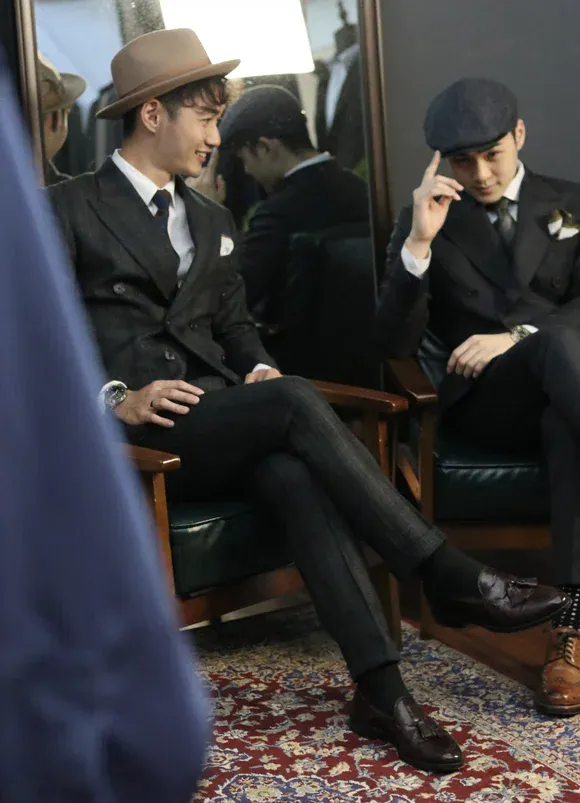
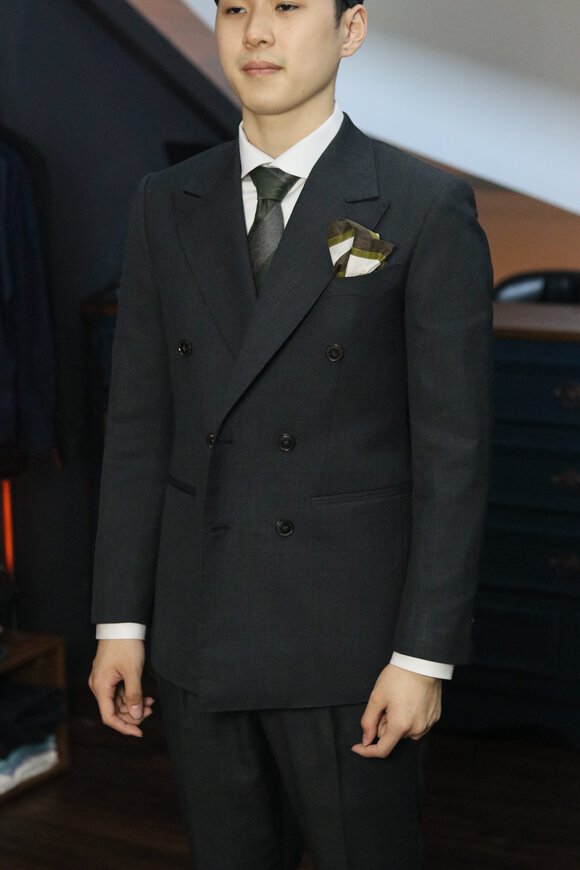
Short answer: there is no single price, because Dormeuil is a range rather than a product. A standard worsted and a rare-fibre cloth come from the same house and cost very different amounts. We quote once you have chosen the cloth and the garment — with the figure attached to every option in front of you, before anything is cut.
A classic worsted and a pure cashmere sit at opposite ends of the same merchant’s range. The book you choose moves the cloth cost more than anything else.
Superfine merino, cashmere, silk and mohair blends cost more per metre than a standard worsted, because the fibre itself is scarcer.
A two-piece suit takes roughly 3.2 to 3.5 metres of 150cm cloth. A three-piece, a larger frame, or a pattern that must be matched across seams all take more.
A suit, a jacket, trousers, or a full three-piece are different quantities of cloth and different amounts of work on the bench.
Full canvas, half canvas, lined or half-lined, hand-finished details — these are decisions about the garment rather than the cloth, and they move the figure too.
We price after you have chosen, not before. At the consultation we put options across the range in front of you with the figure attached to each, so nothing is a surprise.
Held in Singapore, not ordered in blind. Turn the pages, handle the cloth, see it in daylight next to the alternatives — then decide.


Yes. ŠAKAL holds Dormeuil cloth at our atelier at 157A Jalan Besar, Singapore. Tonik Wool is the book we open most often from this house for Singapore clients, and the mohair bunch is worth handling while you are here — mohair mixes suit this part of the world better than most people expect.
Dormeuil was founded in Paris in 1842 by Jules Dormeuil, then twenty-two, importing fine English cloth into France. His brothers Alfred and Auguste joined in 1858 and the firm became Dormeuil Frères in 1860. It opened its first London shop at 10 New Burlington Street in 1871 and New York in 1905. Dominic Dormeuil, of the fifth generation, has led the house since 1999.
Both, and the trade usually gets this wrong in one direction or the other. Dormeuil began as a merchant importing English cloth, and it still selects and sells in the merchant tradition. But it also designs its own cloths and weaves and finishes them at its own premises in Yorkshire, through Dormeuil Manufacturing at Dewsbury, and in October 2025 it acquired the Yorkshire worsted mill Alfred Brown, founded 1915. So neither the flat statement that Dormeuil is only a merchant, nor the claim that it weaves everything itself, is accurate.
Tonik is the cloth Dormeuil is most famous for, created by Xavier Dormeuil in 1957. The original was a three-ply twist of kid mohair and wool — roughly fifty-nine per cent mohair — giving a dry, crisp handle and a faint sheen. It became the defining cloth of the Mod era in Britain, and Michael Caine’s suit in Get Carter was Dormeuil Tonik mohair. Period Tonik was woven far heavier than anything made today.
Tonik Wool is the modern answer for a hot climate: Dormeuil set out to reproduce the dry, crisp character of Tonik in one hundred per cent wool, without the mohair. It is woven from traceable Patagonian wool with high-twist yarns at around two hundred and ninety-five grams, which is nine and a half ounces. It sits squarely alongside the other great high-twists, and it is the Dormeuil book we recommend first for a Singapore business suit.
It is better than its reputation suggests, and it is worth trying before you dismiss it. Mohair is springy and resilient, so a mohair mix resists creasing well and holds a clean line through a long day. It also has a slight sheen, which reads as sleek rather than shiny in the right weight. English tailors report that clients in Southeast Asia often prefer mohair mixes over pure high-twists precisely for that smoother, sleeker look. Come and handle a Tonik alongside a Tonik Wool and you will know within a minute which one is yours.
Our selection covers Tonik Wool and Tropical Amadeus at the hot-climate end; the mohair bunch including Tonik itself; the year-round suitings Amadeus, Amadeus 365 and Echo; and the occasion cloths including Grain de Poudre for black tie. Dormeuil runs a very large bunch programme, so tell us what you are after and we will confirm what is in the atelier before you visit.
Not that we can verify, and we would rather say so than repeat a claim we cannot stand behind. Dormeuil makes no royal warrant claim on its own site and we could not find one on any warrant listing. The house has plenty of genuine history — Sportex in 1922, the woven selvedge in 1927, Tonik in 1957 — without needing that one.
Sportex was created by Pierre Dormeuil in 1922 and is generally credited as the first cloth ever sold under a brand name of its own. Dormeuil marketed it as the fabric of champions, on the back of the house’s sporting associations — it had sponsored the French golfer Arnaud Massy from 1907, and in 1927 made Frilex trousers for the tennis players Lacoste, Cochet, Brugnon and Borotra. It passed its centenary in 2022.
It depends on the book and the construction, so we quote after you have chosen. Tonik Wool and the Amadeus books sit in the middle to upper part of our library; the rare-fibre collections including Royal Qiviuk and Extreme Vicuña sit at the very top. A two-piece suit takes roughly 3.2 to 3.5 metres. At your consultation we put options in front of you with the price attached to each.
Six to eight weeks for a bespoke commission at ŠAKAL, including baste and forward fittings. The cloth usually arrives within one to two weeks of selection.
These are the three we put on the table together, and the choice is about handle rather than performance. Fresco is the original, patented in 1907, and the driest and most textured of the three — the purist’s answer. Fox Air is a two-ply up-twisted worsted with a crisp hand and excellent recovery. Tonik Wool is the sleekest of the three, because it is chasing the character of a mohair cloth in pure wool, and it is usually the one clients pick when they want the high-twist performance without the rustic surface. Ten seconds with all three in your hands settles it.
Yes, and with mohair especially it matters — the sheen that makes Tonik what it is looks quite different in daylight than in any photograph. Everything we hold is in the atelier at Singapore.
Bespoke
FORMAL
2 & 3-Piece Suits
Jackets
Trousers
Shirts
Vest / Waistcoat
Tuxedo / Evening Wear
Overcoat
CASUAL TAILORING
Sport Jacket
Gurkha Trousers
Safari Jacket
Peacoat
Overshirt
CRAFT HALLMARKS