Fox Brothers in Singapore
Fox is credited with creating flannel for suitmaking, and held the trademark on the word itself until the 1950s. Seven generations of one family in Somerset, an archive of pattern going back to 1772, and the chalkstripe that clothed Winston Churchill.
In short: Fox Brothers is an English mill in Wellington, Somerset, founded in 1772 by Thomas Fox and tracing to John Were’s cottage serge in 1680. It is credited as the original creator of flannel for suitmaking and held the trademark on the word until the 1950s. Deborah Meaden and Douglas Cordeaux bought the mill in 2009. ŠAKAL holds its cloth at our atelier in Singapore and cuts it bespoke.
1772
COMPANY FOUNDED
1680
SERGE AT WELLINGTON
7
GENERATIONS OF FOXES
2006
WORLD’S LIGHTEST FLANNEL
Fox Brothers: two and a half centuries in Somerset
The thread starts in 1680, when John Were began making serge in a cottage at Wellington in Somerset. Thomas Fox joined the family business in 1768, became a partner with his uncle Thomas Were in 1772 — the company’s founding date — and sole proprietor in 1796. The name became Fox Brothers in 1826. Seven successive generations of the family ran it.
In 1796 Thomas Fox took over Tonedale Mill, a former flour mill chosen for the water of the River Tone. He was an unusually modern industrialist: he set up his own bank in 1787 to handle supplier and employee payments, and the firm pioneered profit-sharing and worker benefits in 1873.
Fox is officially credited as the original creator of flannel for suitmaking, and held the trademark on the word Flannel up to the 1950s. It also introduced the khaki dye that clothed the British Army, and supplied vast quantities of puttee cloth through the First World War. Its chalkstripe dressed Winston Churchill; the Duke of Windsor and Bob Hope were customers too.
The mill won a Queen’s Award for Export in 1966, the scheme’s inaugural year, and a second in 2006 for making the world’s lightest wool-and-cashmere flannel. Deborah Meaden and Douglas Cordeaux acquired the company in 2009 and launched the retail arm The Merchant Fox in 2011. The 250th anniversary in 2022 was marked with the 1772 Flannel collection.
What Fox Brothers cloth does
Every house has a temperament. This is what to expect from this one, and why we reach for it.
Flannel, from the house that named it
The cloth has body. Close your hand on it and it springs back rather than collapsing, which is what lets a tailor build shape into a garment instead of merely draping it.
An archive back to 1772
Two and a half centuries of pattern in-house. It is why a Fox check does not look like anybody else’s.
Fox Air for the tropics
A two-ply up-twisted worsted at 285 to 315 grams with a crisp dry handle and real crease recovery. The house’s answer to a hot climate.
Genuinely light when it wants to be
The 2006 Queen’s Award was for the world’s lightest wool-and-cashmere flannel. Golden Fox runs at 230 to 260 grams.
Small, and deliberately so
Around twenty-five people making cloth for Savile Row, Ralph Lauren and film studios. This is not volume weaving.
Churchill's chalkstripe
Not marketing. Fox supplied the cloth, and the pattern books that produced it are still in the building.
Holland & Sherry, made up
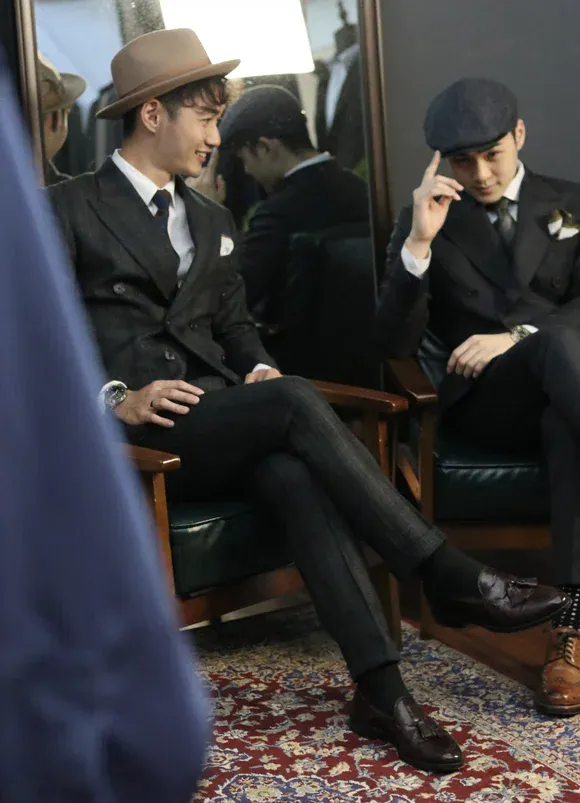
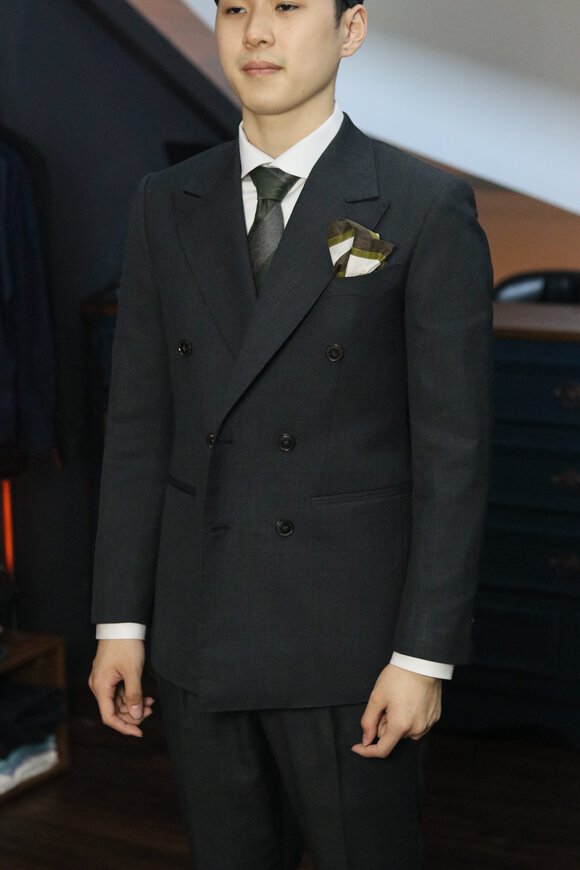
Cloth only tells you so much. This is what it looks like once it has been drafted, cut and finished on Jalan Besar.

What determines the price of a Fox Brothers suit
Short answer: there is no single price, because Fox Brothers is a range rather than a product. A standard worsted and a rare-fibre cloth come from the same house and cost very different amounts. We quote once you have chosen the cloth and the garment — with the figure attached to every option in front of you, before anything is cut.
The book it comes from
A classic worsted and a pure cashmere sit at opposite ends of the same merchant’s range. The book you choose moves the cloth cost more than anything else.
Fibre and rarity
Superfine merino, cashmere, silk and mohair blends cost more per metre than a standard worsted, because the fibre itself is scarcer.
Metreage the garment needs
A two-piece suit takes roughly 3.2 to 3.5 metres of 150cm cloth. A three-piece, a larger frame, or a pattern that must be matched across seams all take more.
What you are having made
A suit, a jacket, trousers, or a full three-piece are different quantities of cloth and different amounts of work on the bench.
Construction
Full canvas, half canvas, lined or half-lined, hand-finished details — these are decisions about the garment rather than the cloth, and they move the figure too.
How we quote
We price after you have chosen, not before. At the consultation we put options across the range in front of you with the figure attached to each, so nothing is a surprise.
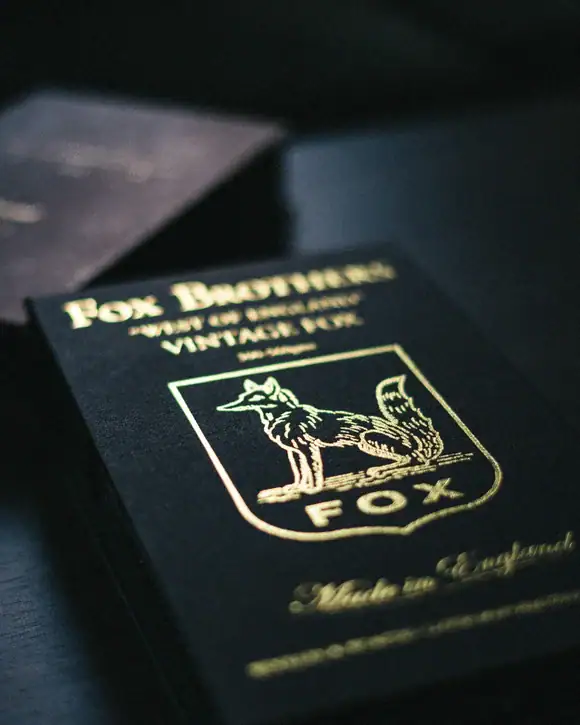
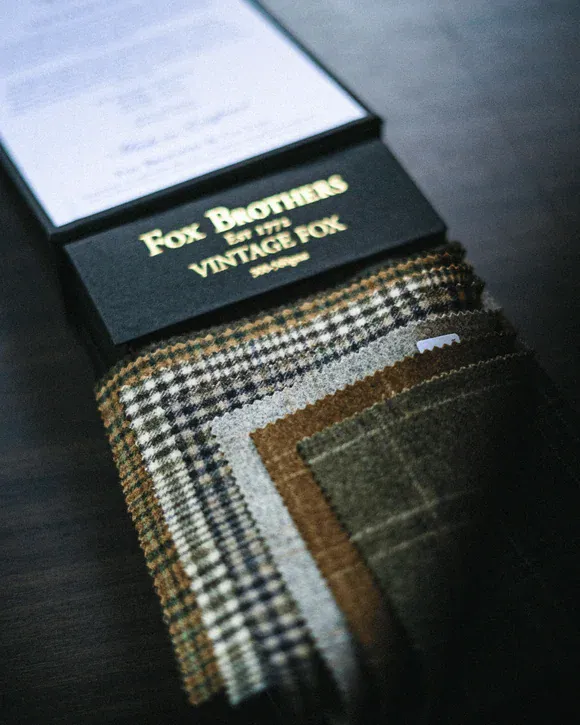
The Fox Brothers books at ŠAKAL
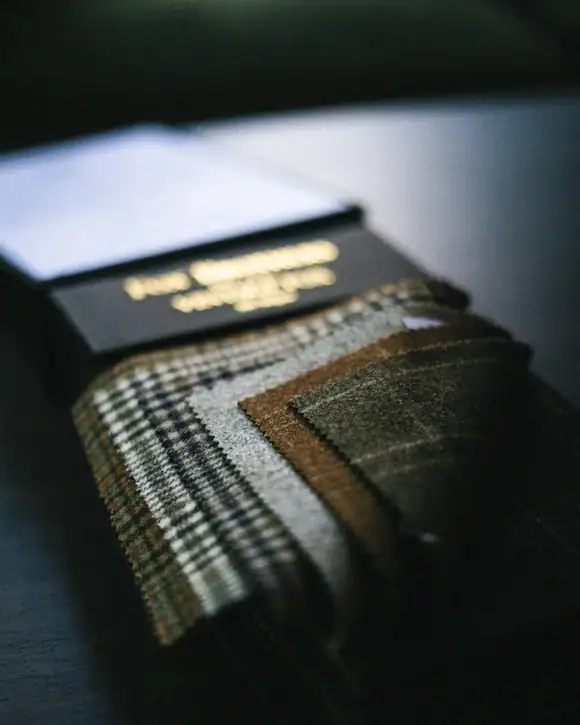
Held in Singapore, not ordered in blind. Turn the pages, handle the cloth, see it in daylight next to the alternatives — then decide.
Fox Brothers, in brief
- Founded
- Traces to
- Named Fox Brothers
- Mill
- Type
- Family
- Flannel
- Ownership
- Retail arm
- Best for
- Held at ŠAKAL
- 1772, Wellington, Somerset, by Thomas Fox
- 1680, John Were's cottage serge at Wellington
- 1826
- Tonedale Mill, taken over 1796 for the water of the River Tone
- Mill — weaves its own cloth in Somerset
- Seven successive generations
- Credited as the original creator; held the trademark on the word to the 1950s
- Deborah Meaden and Douglas Cordeaux, since 2009
- The Merchant Fox, launched 2011
- A proper flannel, and Fox Air for a Singapore business suit
- Yes — bunch books at Šakal, Singapore
Fox Brothers in Singapore, answered
Does ŠAKAL carry Fox Brothers in Singapore?
Yes. ŠAKAL holds Fox Brothers cloth at our atelier at Singapore, including Fox Air, the tropical worsted we cut most often from this house. Fox also issues limited drops in small quantity, which usually need to be brought in — tell us what you are after and we will confirm before you visit.
Who are Fox Brothers?
Fox Brothers is an English woollen and worsted mill at Wellington in Somerset. The business traces to 1680, when John Were began making serge in a cottage there; the company dates from 1772, when Thomas Fox became a partner with his uncle, and took the Fox Brothers name in 1826. Seven generations of the family ran it. Deborah Meaden and Douglas Cordeaux acquired the mill in 2009.
Did Fox Brothers really invent flannel?
Fox is officially credited as the original creator of flannel for suitmaking, and it held the trademark on the word Flannel itself until the 1950s. Woollen cloth of that general type existed earlier, but Fox is the house that developed it into a tailoring cloth and gave it the name we now use. Its 2006 Queen’s Award was for making the world’s lightest wool-and-cashmere flannel, so the development did not stop.
What is Fox Air?
Fox Air is the mill’s tropical worsted, made from two-ply up-twisted — high-twist — yarn at 285 to 315 grams. It has a crisp, dry handle with genuine crease resistance and recovery, and Fox describes it as the ideal travel companion. For Singapore it is the book we open first from this house, and it sits at a very usable weight for a suit worn through a working week.
Which Fox books do you hold?
Our selection covers Fox Air and Golden Fox for year-round and tropical wear; the flannels including 1772 Flannel and Worsted Flannel; Fox Jacketing for odd jackets; and the archive and limited programmes including Vintage Fox and Fox Drop. Fox releases limited cloth regularly, so tell us what you are after and we will confirm what is in the atelier before you visit.
Is flannel wearable in Singapore?
Honestly, not as a suit. Flannel at 400 grams and above is a beautiful cloth and completely wrong for a Singapore afternoon. Where it earns its place here is as an odd trouser or a jacket for a genuinely cold office, or for travel to a colder climate — and it is worth owning for that. If you want Fox cloth for daily Singapore wear, Fox Air and Golden Fox are the right answer.
What did Fox make for Churchill?
Fox supplied the chalkstripe cloth associated with Winston Churchill. The Duke of Windsor and Bob Hope were also customers, and the mill’s khaki dye and puttee cloth clothed the British Army through the First World War. The pattern books behind all of it are still in the building at Wellington.
Is Fox Brothers still made in England?
Yes. Fox weaves its own cloth in Somerset and describes itself as a clothmaker specialising in handmade woollen and worsted fabrics. It is a small operation now — around twenty-five people — supplying Savile Row houses, Ralph Lauren, Gieves & Hawkes and film studios, alongside its own retail arm The Merchant Fox.
How much does a Fox Brothers bespoke suit cost in Singapore?
It depends on the cloth and the construction, so we quote after you have chosen. Fox sits in the middle to upper part of our English range; the archive and limited drops sit above the standing books. A two-piece suit takes roughly 3.2 to 3.5 metres. At your consultation we put options in front of you with the price attached to each.
How long does a Fox Brothers commission take?
Six to eight weeks for a bespoke commission at ŠAKAL, including baste and forward fittings. Standing cloth usually arrives within one to two weeks of selection; limited drops depend on availability and we will be straight with you about that at the consultation.
Fox Brothers or Dugdale Bros — what is the difference?
Both are English and both are unshowy, but they occupy different ground. Dugdale is a Huddersfield merchant whose strength is dependable fine worsted at sensible money, plus two dedicated tropical books. Fox is a Somerset mill with two and a half centuries of its own archive, and its identity is flannel — it named the cloth. Choose Dugdale for a first suit or an everyday business wardrobe; choose Fox when you want cloth with a specific and traceable character, or a proper flannel.
Can I see the Fox cloth before ordering?
Yes. Fox Air in particular has to be handled — the dry, crisp hand and the way it springs back from a crush are the entire argument for it, and neither photographs. Everything we hold is in the atelier at Šakal.