Brisbane Moss in Singapore
Europe’s largest stock-supported range of corduroy and moleskin, woven in Lancashire since 1858. Two Queen’s Awards for Export. This is where a proper pair of cords comes from — and where the flat cottons for a Singapore jacket come from too.
In short: Brisbane Moss is an English cotton mill in Lancashire, founded in 1858 as Moss Brothers Limited at Pecket Well Mill in the Calder Valley. It has been part of The Chapman Group since 1983 and holds Europe’s largest stock-supported range of corduroy and moleskin, alongside flat cottons and linens named after English writers and artists. ŠAKAL holds its cloth at our Jalan Besar atelier in Singapore and cuts it bespoke.
1858
FOUNDED
2
QUEEN’S AWARD FOR EXPORT
1ST
IN EUROPE, CORDUROY STOCK RANGE
6–8
WEEKS, BESPOKE
Brisbane Moss: cotton cloth from the Calder Valley
The company began in 1858 as Moss Brothers Limited at Pecket Well Mill in the Calder Valley, Lancashire — a region so associated with the trade that it was known as Fustianopolis. Fustian is the old family name for the hard-wearing cotton cloths that include corduroy and moleskin, and it has been made here for well over a century and a half. If your hub page or an old listing says 1822, that is a common error; the mill’s own history says 1858.
In 1901 the business became part of the English Fustian Manufacturing Company. In 1970 it acquired Brisbane Jones and the corduroy operation took the name Brisbane Moss Corduroys. Since 1983 it has been part of The Chapman Group, and it now weaves at Chapman Works in Dunnockshaw, Lancashire.
Export success brought Queen’s Awards for Enterprise in International Trade in 2004 and again in 2012. The mill supplies makers across Europe, Japan and North America, and holds what it describes as the largest stock-supported corduroy and moleskin range in Europe — which in practice means a bespoke customer can order a single trouser length in an unusual wale and actually get it.
The naming tells you something about the house. The corduroys go by number and wale count — 3101X, 3124, 530 — while the flat cottons are named for English writers and artists: Blake, Brontë, Byron, Chaucer, Constable, Eliot, Hardy, Keats, Kipling, Shakespeare, Shelley, Tennyson, Turner, Wordsworth. It is an English mill that knows exactly what it is.
What Brisbane Moss cloth does
Every house has a temperament. This one is dry, precise and built to hold its shape — the reason it suits a structured British cut better than anything else we hold.
The largest cord range in Europe
Wale counts from 5 to 16 held in stock, which means you can order one trouser length in the exact rib you want rather than the one that happens to be available.
Moleskin, properly made
Dense woven cotton with a brushed face that feels like suede and wears like iron. It softens with every wash rather than wearing out.
Flat cottons for this climate
The writers-and-artists range is where Singapore actually lives — cotton twills, gabardines and drills for odd trousers and unstructured jackets.
Lancashire weaving
Woven at Chapman Works in Dunnockshaw. The Calder Valley has made this cloth since before the mill was founded.
Twice a Queen's Award
For Export in 2004 and 2012. Small mills do not win those twice by accident.
Cotton, not wool
Worth saying plainly. This is a cotton house. It is not where you go for a business suit — it is where you go for everything else in the wardrobe.
Brisbane Moss, made up
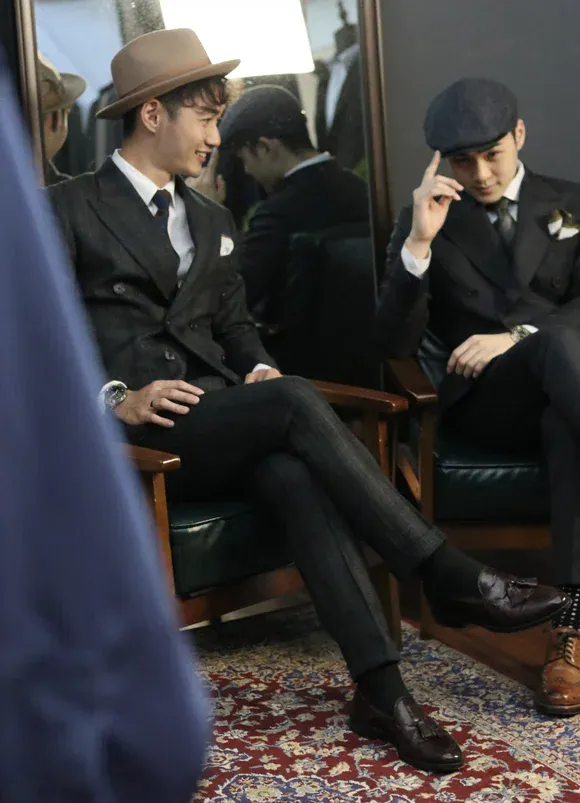
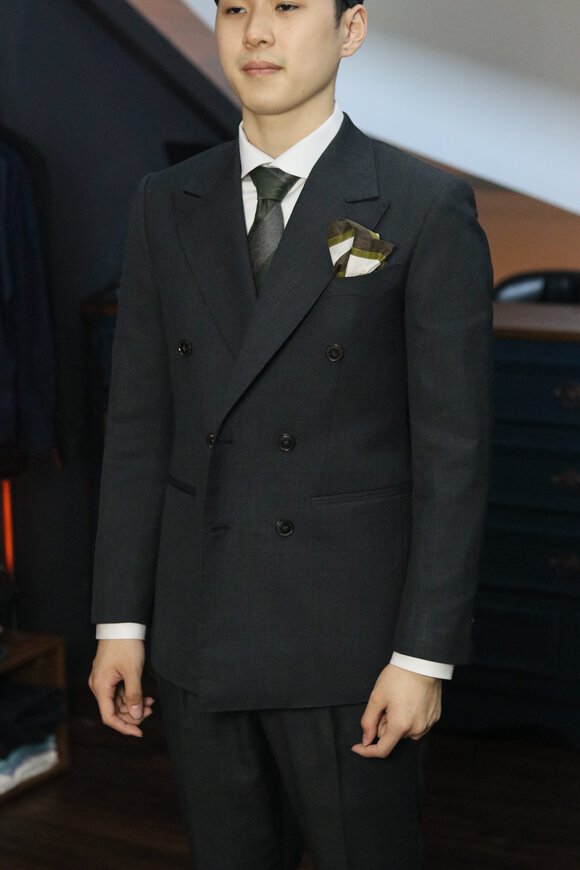
Cloth only tells you so much. This is what it looks like once it has been drafted, cut and finished on ŠAKAL.

What determines the price of a Brisbane Moss trouser
Short answer: there is no single price, because Brisbane Moss is a range rather than a product. A standard worsted and a rare-fibre cloth come from the same house and cost very different amounts. We quote once you have chosen the cloth and the garment — with the figure attached to every option in front of you, before anything is cut.
The book it comes from
A classic worsted and a pure cashmere sit at opposite ends of the same merchant’s range. The book you choose moves the cloth cost more than anything else.
Fibre and rarity
Superfine merino, cashmere, silk and mohair blends cost more per metre than a standard worsted, because the fibre itself is scarcer.
Metreage the garment needs
A two-piece suit takes roughly 3.2 to 3.5 metres of 150cm cloth. A three-piece, a larger frame, or a pattern that must be matched across seams all take more.
What you are having made
A suit, a jacket, trousers, or a full three-piece are different quantities of cloth and different amounts of work on the bench.
Construction
Full canvas, half canvas, lined or half-lined, hand-finished details — these are decisions about the garment rather than the cloth, and they move the figure too.
How we quote
We price after you have chosen, not before. At the consultation we put options across the range in front of you with the figure attached to each, so nothing is a surprise.
The Brisbane Moss books at ŠAKAL
Held in Singapore, not ordered in blind. Turn the pages, handle the cloth, see it in daylight next to the alternatives — then decide.


Holland & Sherry, in brief
- Founded
- Not 1822
- 1901
- 1970
- Ownership
- Mill
- Type
- Awards
- Fibre
- Best for
- Held at ŠAKAL
- 1858, as Moss Brothers Limited, Pecket Well Mill, Calder Valley, Lancashire
- The mill's own history gives 1858; the earlier date is a common listing error
- Part of the English Fustian Manufacturing Company
- Acquired Brisbane Jones; became Brisbane Moss Corduroys
- The Chapman Group, since 1983
- Chapman Works, Dunnockshaw, Lancashire
- Mill — weaves its own cotton cloth
- Queen's Awards for Export, 2004 and 2012
- Cotton and linen. Not a wool house.
- Odd trousers, unstructured jackets, and a proper pair of cords
- Yes — bunch books at Singapore
Brisbane Moss in Singapore, answered
Does ŠAKAL carry Brisbane Moss in Singapore?
Yes. ŠAKAL holds Brisbane Moss cloth at our atelier at 157A Jalan Besar, Singapore. In practice we open the flat cotton books most often here — the range named for English writers and artists — because those are the cloths that work in this climate. The corduroys and moleskins are available too, and we will be honest with you about where they belong.
Who are Brisbane Moss?
Brisbane Moss is an English cotton mill in Lancashire. It was founded in 1858 as Moss Brothers Limited at Pecket Well Mill in the Calder Valley, became part of the English Fustian Manufacturing Company in 1901, acquired Brisbane Jones in 1970, and has been part of The Chapman Group since 1983. It holds Europe’s largest stock-supported range of corduroy and moleskin and has won two Queen’s Awards for Export.
Was Brisbane Moss founded in 1822 or 1858?
1858. The mill’s own published history dates the business to 1858, when it began as Moss Brothers Limited at Pecket Well Mill. The 1822 date circulates in various online listings, including on some tailors’ pages, but it is not what the mill says about itself. We have corrected it here.
Can you wear corduroy in Singapore?
Not comfortably as a suit, and we will say so. Corduroy is a substantial cotton cloth with a raised pile, and in Singapore humidity it is warm. Where it makes sense here is for travel to a colder climate, or a single well-made pair for a genuinely cold office. If you want Brisbane Moss cloth for daily Singapore wear, the flat cottons are the answer — and they are excellent.
What is wale, and which should I choose?
Wale is the number of ribs per inch in a corduroy, and it is the single thing that changes the character of the cloth. A low count means wide, bold ribs — Coniston at five wale is the statement end. A high count means fine, subtle ribs — Cedar at sixteen reads almost as a plain cloth from across a room. The flagship 3101X sits at eight wale, which is the classic middle ground for a trouser.
What is moleskin?
Moleskin is a densely woven cotton with a short brushed nap on the face, which gives it a soft, suede-like handle. It is heavy, wind-resistant and extraordinarily hard-wearing — a proper moleskin trouser gets better with washing rather than wearing out. Like corduroy it is a cold-weather cloth, so in Singapore it is for travel rather than daily wear.
Which Brisbane Moss books do you hold?
Our selection covers the flat cottons named for English writers and artists — Blake, Brontë, Chaucer, Shakespeare, Tennyson and the rest — which are what we cut most often here; the Montecarlo linen book; the corduroys including 3101X, 3124 and Cedar; and the moleskins. Tell us what you are after and we will confirm what is in the atelier before you visit.
Do you make jackets from Brisbane Moss cotton?
Yes, and it is one of the better answers to the Singapore jacket problem. A soft, unstructured jacket in a cotton twill or gabardine from the flat range gives you the shape of tailoring without the weight of a canvassed wool coat. It creases — cotton does — but that is part of the character rather than a fault.
How much does a Brisbane Moss bespoke trouser cost in Singapore?
It depends on the cloth and the make, so we quote after you have chosen. Cotton generally sits at the accessible end of our library relative to fine worsted. A pair of trousers takes roughly 1.4 to 1.6 metres. At your consultation we put options in front of you with the price attached to each.
How long does a Brisbane Moss commission take?
Six to eight weeks for a bespoke commission at ŠAKAL, including fittings. The cloth usually arrives within one to two weeks of selection, and because the mill holds a large stock range, unusual wale counts are more available than you might expect.
Brisbane Moss or Baird McNutt — which for warm-weather separates?
Different fibres for different results. Baird McNutt is Irish linen — cooler, drier and more open, with the honest crumple that linen brings. Brisbane Moss is cotton — a little more body, a cleaner line, and it holds a crease better. For a Singapore odd trouser we would show you both: linen if you want maximum air and do not mind the rumple, cotton if you want the trouser to look tidier at four in the afternoon.
Can I see the cloth before ordering?
Yes, and with corduroy it matters more than most — wale count is impossible to judge from a photograph and completely obvious in the hand. Everything we hold is in the atelier at Singapore.