Baird McNutt in Singapore
Irish linen was once an industry. It is now very nearly a memory — and Baird McNutt is what survives, weaving at a mill on the Kellswater that has been making linen since 1798. The same loom shed serves Savile Row and the label in a J.Crew shirt.
In short: Baird McNutt is a Northern Irish linen weaver at Kells, Ballymena. Three dates matter: the mill at Shankbridge was established in 1798, W.F.B. Baird & Co was founded at Lurgan in 1912, and the Baird McNutt name dates from the 1991 merger with the McNutt family’s Donegal design house. It weaves, dyes and finishes at Kells. ŠAKAL holds its linen at our atelier in Singapore and cuts it bespoke.
1798
LINEN AT SHANKBRIDGE MILL
1912
W.F.B. BAIRD FOUNDED
240
G/M2 GLENARIFF SUITING
4
GENERATIONS OF BAIRD
Baird McNutt: three dates, one mill
There is no single founding year here, and anyone who gives you one is simplifying. Shankbridge Mill at Kells, on the Kellswater in County Antrim, was established by John Hanna in 1798 and has been making linen ever since. W.F.B. Baird & Co was founded separately at Lurgan in 1912 by William Frederick Burgoyne Baird. Baird acquired John Hanna of Kells in the late 1960s for its dyeing and finishing.
The Baird McNutt name itself dates from 1991, when the Baird operation merged with the McNutt brothers’ design house in Downings, County Donegal. Peter McNutt is still the designer behind the cloth, and the Kells mill became the manufacturing home.
They weave, dye and finish at Kells on rapier looms, with pad dyeing at over ninety per cent fixation, air-tumbled waterless finishes and on-site effluent treatment. They do not spin — Irish flax spinning effectively ceased decades ago and yarn is bought in, which is true of every linen weaver on the island today.
Peter McNutt explains why so few can do this: linen is not forgiving at all. It’s a brittle yarn. It snaps at around two per cent tension, against roughly eight per cent for cotton. Loom settings and yarn treatment are closely guarded, which is a large part of why the trade shrank to a handful of houses. The company is now in the fourth generation of the Baird family.
What Baird McNutt cloth does
Every house has a temperament. This is what to expect from this one, and why we reach for it.
A crisp, dry hand
Irish linen has a dryness that continental linen does not quite match. It feels cool against the skin from the first minute, which is the entire argument for it in this climate.
Mercerised and fully shrunk
Glenariff, the flagship suiting at 240 g/m², is mercerised and fully shrunk before it reaches you. That is what stops a linen suit turning into a different garment after its first clean.
It creases, and that is the point
Nobody should sell you a crease-free linen. The rumple is the character. What good linen does is crease handsomely rather than limply, and soften over years rather than months.
Woven where it always was
The Kellswater mill has made linen since 1798. There is no marketing department that can manufacture that.
Colour from a Donegal studio
The McNutt side brought design, and the colour range is why Baird McNutt ended up in international fashion as well as bespoke tailoring.
Flax is a low-impact crop
Rain-fed, no irrigation, and the company reports each hectare of flax capturing around 3.7 tonnes of CO2. Linen is one of the genuinely defensible natural fibres.
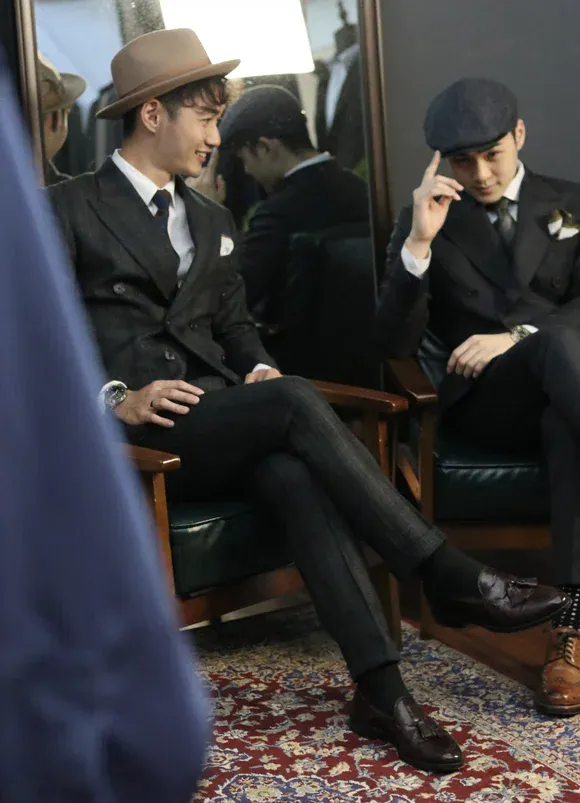
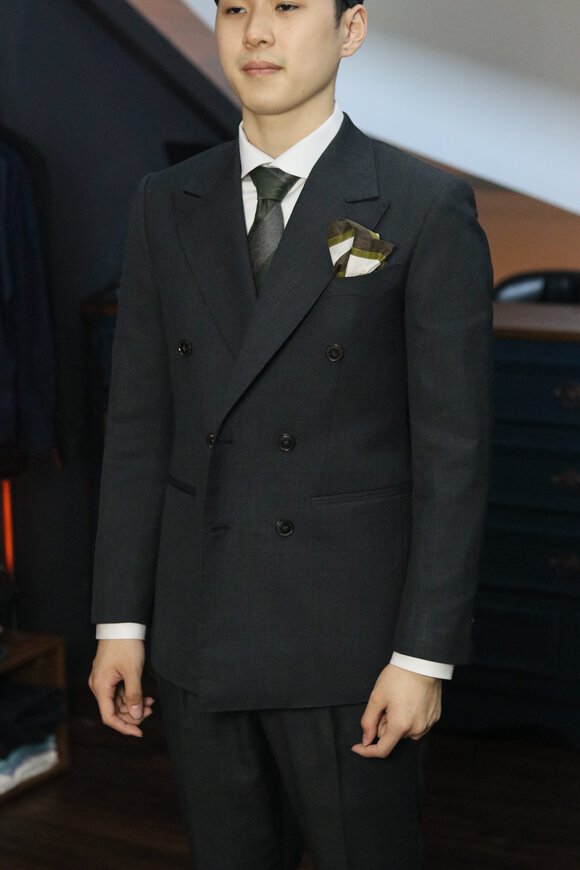
Baird McNutt, made up
Cloth only tells you so much. This is what it looks like once it has been drafted, cut and finished on ŠAKAL.

What determines the price of a Baird McNutt suit
Short answer: there is no single price, because Baird McNutt is a range rather than a product. A standard worsted and a rare-fibre cloth come from the same house and cost very different amounts. We quote once you have chosen the cloth and the garment — with the figure attached to every option in front of you, before anything is cut.
The book it comes from
A classic worsted and a pure cashmere sit at opposite ends of the same merchant’s range. The book you choose moves the cloth cost more than anything else.
Fibre and rarity
Superfine merino, cashmere, silk and mohair blends cost more per metre than a standard worsted, because the fibre itself is scarcer.
Metreage the garment needs
A two-piece suit takes roughly 3.2 to 3.5 metres of 150cm cloth. A three-piece, a larger frame, or a pattern that must be matched across seams all take more.
What you are having made
A suit, a jacket, trousers, or a full three-piece are different quantities of cloth and different amounts of work on the bench.
Construction
Full canvas, half canvas, lined or half-lined, hand-finished details — these are decisions about the garment rather than the cloth, and they move the figure too.
How we quote
We price after you have chosen, not before. At the consultation we put options across the range in front of you with the figure attached to each, so nothing is a surprise.
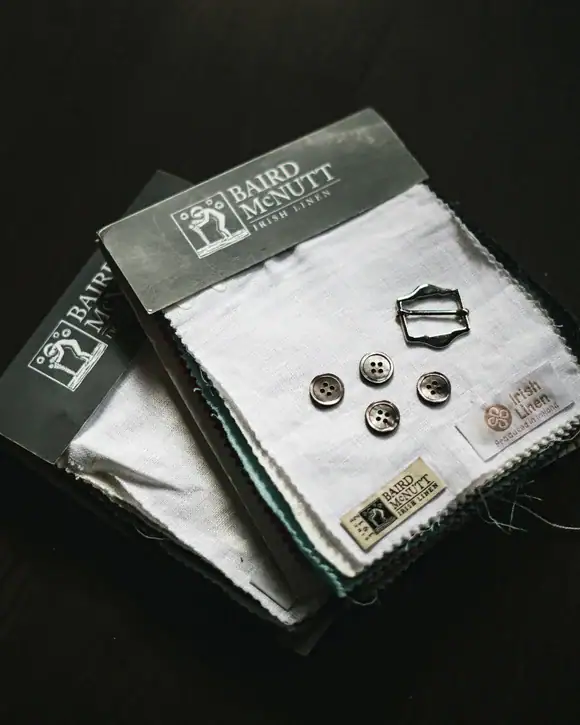
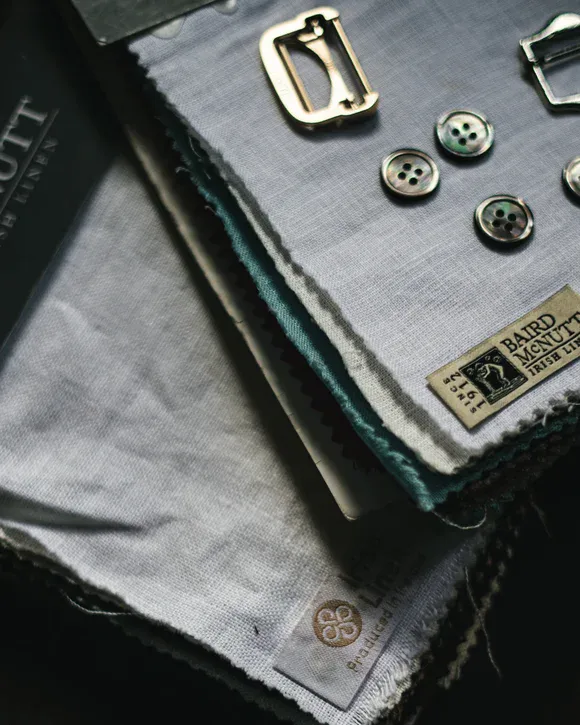
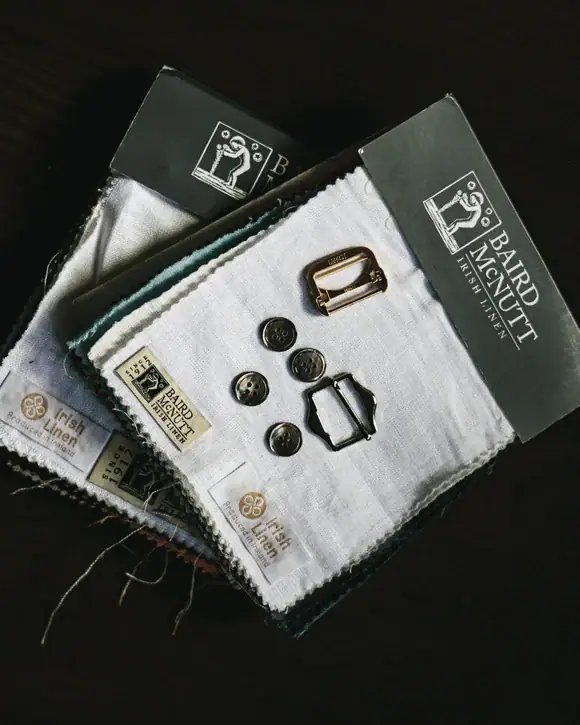
The Baird McNutt books at ŠAKAL
Held in Singapore, not ordered in blind. Turn the pages, handle the cloth, see it in daylight next to the alternatives — then decide.
Baird McNutt, in brief
- Mill established
- Company founded
- The name
- Where
- Type
- Design
- Ownership
- Flagship suiting
- Character
- Best for
- Held at ŠAKAL
- 1798, Shankbridge Mill, Kells, Co. Antrim, by John Hanna
- 1912, Lurgan, by William Frederick Burgoyne Baird
- Baird McNutt, from the 1991 merger with the McNutt design house, Donegal
- 72 Shankbridge Road, Kells, Ballymena, Co. Antrim
- Weaver, dyer and finisher — not a spinner
- Peter McNutt, from a studio at Downings, Co. Donegal
- The Baird family, fourth generation
- Glenariff, 100% Irish linen, 240 g/m², mercerised and fully shrunk
- Crisp, dry, cool against the skin. Creases — deliberately.
- Outdoor weddings, daytime events, and anything in full Singapore sun
- Yes — bunch books at Singapore
Baird McNutt in Singapore, answered
Does ŠAKAL carry Baird McNutt linen in Singapore?
Yes. ŠAKAL holds Baird McNutt Irish linen at our atelier at Singapore, including the Glenariff suiting we cut most often for outdoor weddings and daytime events. The cloth is in the shop rather than ordered in on request, so you can handle it in daylight before committing.
Who are Baird McNutt?
Baird McNutt is a Northern Irish linen weaver based at Kells, Ballymena, in County Antrim. Its mill at Shankbridge was established in 1798 by John Hanna and has made linen ever since. W.F.B. Baird & Co was founded separately at Lurgan in 1912, acquired the Kells mill in the late 1960s, and merged with the McNutt family’s Donegal design house in 1991 to create the Baird McNutt name. It is now in the fourth generation of the Baird family.
When was Baird McNutt founded?
There is no single answer, and it is worth knowing all three dates. The mill site at Shankbridge dates from 1798. The Baird linen business was founded in 1912. The Baird McNutt brand itself dates from the 1991 merger with the McNutts. Anyone quoting you one founding year is compressing three separate histories.
Do they still spin the linen in Ireland?
No, and it is worth being straight about it. Baird McNutt weaves, dyes and finishes at Kells, on rapier looms, with its own effluent treatment on site. It does not spin. Irish flax spinning effectively ceased decades ago and yarn is bought in, which is true of every linen weaver on the island today. What survives in Northern Ireland is the weaving, dyeing and finishing craft — and Baird McNutt is very nearly the last large-scale apparel linen weaver doing it.
Which Baird McNutt qualities do you hold?
Our selection centres on Glenariff, the 240 gram mercerised suiting, along with Milltown, Milestone Twill and Parkgate Twill for suiting and jacketing; the lighter Glebe and Drumbeg for unstructured jackets and trousers; and Glenarm at 149 grams for shirting. Colours and qualities rotate, so tell us what you are making and we will confirm what is in the atelier before you visit.
Is linen a sensible choice for Singapore?
For the right garment, it is the best choice there is. Nothing breathes like linen, and in full sun at an outdoor wedding or a daytime event there is genuinely no substitute. What it will not do is stay smooth — linen creases, and anyone selling you a crease-free linen is selling you a blend. Our advice is to embrace it: a Glenariff jacket that has softened and rumpled over three summers looks far better than a new one.
Why does Irish linen cost more than other linen?
Partly scarcity and partly difficulty. Linen yarn is brittle — it snaps at around two per cent tension against roughly eight per cent for cotton — so weaving it demands loom settings and yarn treatment that very few mills still know. The Irish trade shrank from an industry to a handful of houses. Baird McNutt’s mercerising and full shrinking add cost too, and they are the reason the suit still fits after its first clean.
What is the difference between Glenarm and Glenariff?
They are easy to confuse and quite different cloths. Glenarm is 149 g/m² and is a shirting weight. Glenariff is 240 g/m², mercerised and fully shrunk, and is the flagship suiting. Several Baird McNutt qualities share similar Irish place names, so it is worth naming the weight as well as the name when you order.
How much does a Baird McNutt linen suit cost in Singapore?
It depends on the garment and the construction, so we quote after you have chosen. Linen sits in the middle of our range rather than at the top. A linen jacket is often the better first commission than a full suit — more wearable here, and it lets you see how the cloth ages. At your consultation we put options in front of you with the price attached to each.
How long does a linen commission take?
Six to eight weeks for a bespoke commission at ŠAKAL, including baste and forward fittings. If you are commissioning for a specific outdoor wedding, come to us earlier rather than later — linen is worth a full fitting cycle because it moves differently from wool on the body.
Baird McNutt or Solbiati — what is the difference?
Both are serious linen houses and the choice is about character. Irish linen from Baird McNutt has a crisp, dry hand and a cooler feel against the skin — it is the more traditional and the more structured of the two. Solbiati, from Busto Arsizio, finishes its Italian linen softer and does more in linen-wool and linen-silk blends, which drape more fluidly and crease a little less. Choose Baird McNutt for a proper linen suit or jacket in full sun; choose Solbiati when you want linen’s coolness with a softer hand.
Can I see the linen before ordering?
Yes, and with linen it is essential. The difference between a 149 gram shirting and a 240 gram suiting is enormous in the hand, and colour in linen behaves differently in daylight than under a shop light — which matters if the garment is for an outdoor event. Every quality we hold is in the atelier at Singapore.